Friday, February 26, 2021

Conflict of Interest

Object is closer than it appears.

I hate carnivores.

(3...2...1) 

[SFX: audible sigh] 

Okay, that's not true. I don't hate carnivores.

IN FACT: during the wildlife documentaries where the relentless wolf chases the cute, innocent widdle bunny wabbit...I'm the guy cheering for the wolf.

Lions and tigers and bears gotta make a living, ya know.

[SFX: angry, conflicted muttering]

BUT NOT IN OUR BACK YARD

No, our LITERAL back yard, where our chickens live and recently have been stalked by coyotes and hawks.

The hawks have vexed us for a while now, TBH, but the coyotes are new. And frankly it's wracking my nerves. Every time a crow caws out back (crows are amazing first-alert alarms) I rush to the window at defcon 1.

"Let's see if this gate opens!"
If it's a hawk in the tree above the yard, I hustle out to the deck to fling pine cones and epithets until it gets bored and flies off.

If it's a coyote outside the fenceline, I fly madly down the stairs, grabbing a big stick on the way out the door. I've actually had to charge the fence, shouting and banging the fence posts before the critter will retreat. 

Would I take a home run swing at a coyote's backside if I got the chance? Why yes, yes I would. We sincerely love the urban wildlife—but we love our hens more. Sorry, not sorry.

[SFX: audible sigh]

Thankfully, urban coyotes are way too smart to stand around waiting to be whacked by soft-walkers carrying big sticks.
***
It turns out urban carnivores are *everywhere* in metro Seattle. There's an online tracker that aggregates reported sightings of black bears, bobcats, mountain lions, opossums, raccoons, red foxes, and [checks notes] river otters? 

See the swarms of yellow dots? Coyotes. See the red circle? Our neighborhood. And these are just the sightings that have been reported. Frankly, I don't know how any of us have survived as long as we have.
"Look, I'm telling you, there's something moving 
and it ain't us! Tracker's off the scale, man.
They're all around us, man. Jesus!"
***
It's been a few days now since the last coyote incursion. We don't know if our "coyote hazing" measures worked, if they found easier prey elsewhere, or if they'll be back when the mood strikes them. Living creatures are unpredictable.

What we DO know is that there are no villains in the wildlife food chain. They're all just doing their best to survive, and some of them are better at it than others. We can't hold that against them.

Our inclination will always be to live and let live—us on our side of the fence, them on theirs.

[contemplative pause]

I'm not getting rid of the big stick, tho.


Thursday, February 04, 2021

Urban Direwolf

"Round he throws his baleful eyes
That witnessed huge affliction and dismay"
—Milton, Paradise Lost

"Normal life in an abnormal time tends to become abnormal."

—Newton's First Law of WTF
***
CASE IN POINT: coyotes in our neighborhood.

We'd heard the rumors, but we hadn't seen the real articles.

Until oh-dark-thirty this morning.

The dogs and I always get out early. It's just easier that way, since the three of them are disorderly in the best of circumstances, and the one of me is barely able to contain their nonsense.

TODAY three runners ran by us, and were flagged down by a passing car. I couldn't hear the conversation, but I imagined it had something to do with their running in the road in the dark.

Nope. The same car pulled up next to us and the driver hollered, "I just passed two coyotes. Not sure if they'll attack dogs or people."
Me: "How far up?"
Him: "Just by the entrance to the park."
Me: "Okay, thanks for the tip!"

As a result of that conversation, did I expect to see coyotes? I did not. Because though we'd heard multiple, credible reports of their presence in the past few weeks, I HAD NOT PERSONALLY SEEN ONE...therefore they couldn't possible exist.

Besides, THE park in our neighborhood is Discovery Park, the closest entrance to which was nearly two miles away. Dude MAY have seen coyotes up there, but we were down here, and never the twain shall meet.

HAHA. I'm an idiot.

Not just because coyotes travel, but because there was another small park (more of a scenic overlook, really) about 150 yards up the hill from where we were.

Toward which we kept walking, ignorant, blissful, oblivious.

The time between the friendly warning and the coyote encounter was brief. Three or four minutes, tops. I saw it first, which is inexplicable since there are no streetlights on that stretch of road, and it's still quite dark here at 5:45 a.m. PLUS I was traveling with three dogs, one of which is supposed to be an LGD (which stands for "livestock guardian dog"). But I'm the one who spots the direwolf in the dark??

Not cool, dogs. Not cool at all.
Representative coyote.
Actual coyote may vary.


I turned on my headlamp and pointed it {gestures over there in the underbrush}. The coyote froze, its eyes shining back at us...and THAT'S when the LGD barked.

Fortunately, when a Great Pyrenees barks, people (and other creatures) listen. The coyote turned and bolted up the hill, whilst I wrangled the dogs back down the hill. No need for an early morning confrontation with the local wildlife after all, wot?

Was I remembering the guy distinctly said, "two coyotes"? I WAS.
Did I continue looking back over my shoulder whilst we hustled away? I DID.

The rest of the walk was boring. Standard dog hijinx. We get that here every day. {sighs}

Back home, we had barely gotten in the door and I could already hear our chickens fussing out back.

"Two urban coyotes walk into an urban chicken farm, and the first one says {nothing because coyotes don't talk with their mouths full}."

UPDATE: The chickens are fine.

So far.

But I'm confident that will not remain the case if the coyotes get a craving for poultry cacciatore.

Saturday, January 09, 2021

Quietude

The thing I notice most is the quiet. 

Sitting here on the back porch, looking across farm fields and ranch land, there is sound, of course. But it's of a kind that soothes rather than rattles. Cows lowing, sheep baa-ing, birds chirping and cooing and crowing. 

What's missing, but not missed, is the constant jangle of human sound. It's not entirely absent, but it is gracefully subdued and intermittent. A far-off tractor working a field. A car slowly rolling by on a one-lane road half-a-mile down the hill. A plane 30,000 feet above.

As I sit here, no actual humans are in sight. Cows, goats, doves and cardinals are accounted for—as are a couple of romping dogs and what I assume is an 'io, the native Hawaiian hawk. Whatever sound it might be making is carried away by the wind. 

After a while, a horse and rider appear, ambling along the road below. They're in no hurry, maybe just soaking up some mid-morning sun.

A bit later, several geese complain loudly about something unseen. I look up to see four of them, in a row, hurrying up the road—cheerfully chased by a young boy.

Further down the slope, the endless blue of the Pacific Ocean stretches to the horizon. If you were to sail north from here, on the Hamakua Coast of the Big Island, your next stop would be Alaska—with nothing but water in between.
***
This low, agrarian hum is a welcome change from our urban soundtrack. 

Dogs barking outdoors, at a distance, blend into the background. Dogs barking indoors, at close range, are akin to sudden jackhammering in a library.

A tractor rumbling through a far-off field is pastoral. A police car speeding by with sirens blaring is like a tractor rumbling through the living room.

A tiny baby goat carried by a young girl in the local grocery store is endearing and adorable. A tiny baby goat carried by a young girl at an urban Whole Foods is...okay, that's still endearing and adorable. Never mind.
***
It's amazing how quickly and completely my routine has changed in the few days I've been here. I'm eating better, exercising more, and deep-breathing without having to remind myself to take a damn breath.

We're still months away from moving here full time, but I expect this pattern to hold when we do.

I'm heading back to Seattle soon. 

I'll be taking as much of the quiet with me as I can. 


Thursday, January 07, 2021

The American Ceaușescu

"The line must be drawn here.
This far
, no further."
I had other ideas for a post today, but they no longer matter.

The only thing that matters right now is what happened yesterday in Washington, DC.

Violent insurrection by right-wing terrorists was instigated and cheered on by an old white man in an undeserved position of power.

Under more normal circumstances, it'd be prudent to say that man should be impeached and removed from office in an orderly fashion. 

But these are the most abnormal circumstances of our lifetime. 

The thing we all thought couldn't happen here has happened—for all the world to see. How and why doesn't matter right now—what does matter is putting a hard stop to it and beginning the process of ensuring it never happens again.

From the false president to complicit members of congress to the racist bastard who paraded a confederate flag through the People's House—every one of them should be arrested, held without bail, and face charges of high crimes against the United States.

Democracies around the world, many of which have a first-hand history of violent collapse, are warning the same can happen to the US. 

“After our catastrophic failure in the 20th Century, we Germans were taught by the US to develop strong democratic institutions. We also learnt that democracy is not just about institutions. It is about political culture, too. All democratic nations need to constantly defend it." —Andreas Michaelis, German ambassador to the UK.

"I follow with great concern what is happening in Washington. Violence is incompatible with the exercise of political rights and democratic freedoms." —Italian Prime Minister Giuseppe Conte.

Even the Turkish foreign ministry, in the name of all that's deeply hypocritical, called for restraint: "Turkey is monitoring worrying developments in the US, including attempts to storm the Capitol building. We believe that the US will overcome this domestic crisis calmly.”

From a 2018 post:

"It was only 30 years ago that Nicolae Ceaușescu was executed by firing squad in Romania.

"45 is clearly no student of history, but he seems to be modeling himself in Ceau
șescu's mold:

"'Life in Romania during the regime of Nicolae Ceau
șescu was at once tragic and absurd as the nation’s head of state erected a cult of personality that literally turned his country into a stage show. Ceaușescu scripted an epic with himself as the star, but others wrote the inevitable denouement that brought down the curtain on him and his wife, Elena...'"

"I don't (yet) believe the end of 45's story will mirror Ceaușescu's, but sitting here today, I also wouldn't rule it out."
***
That threat is now reality, and the line is drawn: US democracy or a renegade president.

Trump must resign or be removed. 

If he won't step down, he should be dragged from the White House by his feet.

Saturday, January 02, 2021

There Is No Normal

“What was the last normal thing you did before the pandemic?”

That wistful question recently (and briefly) trended on twitter, and it got me thinking.....and I honestly couldn't remember.

(Stipulating that "before" is meaningless because the pandemic has always been here.)

I scrolled back to Instagram posts from late February looking for shots that weren't taken under a COVID pall—and found photos from a 20-mile trail run with friends. The caption captured the day:
Trail running, circa 1895.

"Trail time is great for solving all the world’s problems. Also for frivolous fun, cultural curiosities, and a lot of alliteration."

That day was blithely normal and oblivious to the chaos at the gates. Two weeks later I was on a plane to San Diego, fetching our daughter home from college.

It will take historians years to sort out what happened next, but the most generous executive summary would read something like, "A highly transmissible virus was loosed in the world, exposing weakness in social structures that fueled explosive spread of the disease. In one country, sadistic indifference by the federal government made the pandemic far worse than it should have been, killing hundreds of thousands who needn't have died. A significant percentage of the population followed the government's example, accelerating the spread of the disease and eroding civic norms required for a successful society to survive."

2020 has broken our hearts in obvious and subtle ways. We will never recover from the massive death toll, no matter how much the current administration would like us to ignore it. We've lost whatever spurious claim we had to 'the greatest country in the world," and no genuflecting to a flag can change that.

We've discovered we can't trust many of our neighbors to do the right thing, or the smart thing, or even the decent thing. They will put themselves—and therefore the rest of us—in danger without batting an eye.

We've learned some of them are so broken they will literally sabotage our supply of vaccines.

How do we recover from that, emotionally and pragmatically?

When every interaction is fraught with real, empirical risk, how do we allow new people into our circle? Openly and happily, without suspicion? 

My impulse is to say, "We don't." And that's coming from someone who used to give everyone the benefit of the doubt. Like the kid in The Polar Express, I *wanted* to believe. I wanted to hear that fucking bell ring. And it did, for a long time.

We can forgive, maybe. But we can't forget.
***
In a few months, possibly longer, many of us will be vaccinated. In the spirit of a new year, a more pleasant question: "What's the next normal thing you'll do after the pandemic?"

I want to cook for people. Lots of people. I want to stand in a warm kitchen, talking above the music, laughing with people I love. I want to fill up a tub with ice and beer. I want to bust out the "good wine" we've saved for a long-deferred special occasion.

I want to see people I haven't seen IRL in forever. I want to greet them at the door with long, tearful hugs and laugh about that, too. 

I want to turn on the outdoor party lights as the sun goes down, and when everyone's been fed I want to sip a beer in a quiet corner and watch everyone get in-person re-acquainted. I want to memorize the smiles and the brilliant little jokes and the sad stories.

And as they drift off into the evening, I want to tell them all we'll see them in a week or two, and we'll do the whole thing all over again.

Just because we can.
***
Nothing will change what we learned about ourselves and each other in 2020. For good and ill, it happened, and there's no going back.

All we can do is move forward. And find ways to be new-normal again.

Tuesday, December 22, 2020

Mallvolution

Once upon a time, huge shopping malls roamed the Earth.

They competed with one another to see which could cover the most land with concrete and steel to claim the title of "world's biggest."

The fossilized remains of Metrocenter Mall.
(Jesse Rieser for The New York Times)
Now, not sadly, those beasts are mostly gone, replaced by digital analogues.


Today, in the pages of another anachronism, this photo caught my attention —>

Back in the day I worked at a restaurant near the Metrocenter Mall in Phoenix, AZ. 

It was a raucous little establishment most nights, attracting customers looking for other attractive customers, inexpensive food, and maybe a drink or three.

During the NBA season, visiting teams would come in after their games with the Phoenix Suns. I met a lot of players that year—Reggie Theus, Larry Micheaux, Adrian Dantley, Danny Schayes, Otis Thorpe, Rick Robey—which seemed kind of cool at the time.

More importantly, I met a girl there who would eventually agree to marry me. That, of course, was super cool.

Back to our allegory:

Eventually and relentlessly, the retail environment evolved. Lumbering anchor stores like Sears and JC Penney were overrun by more nimble competitors. Omnivorous predators like Walmart, Costco, and Amazon devoured local traffic, and then came the asteroid strike known as COVID-19.

After 47 years, Metrocenter, much like this allegory, expired in 2020.

The End.
***

Lex: What are you and Ellie gonna do now if you don't have to pick up dinosaur bones anymore?

Dr. Alan Grant: I don't know. I guess...I guess we'll just have to evolve.

Sunday, December 20, 2020

Holly Jolly, Holly Jolly, No!

Winter Weather Advisory for Big Island Summits
Wintry mix of freezing rain with periods of snow.
Additional snow accumulations of up to two inches.

When we signed up for life on an island in the middle of the Pacific it didn't occur to us we'd need to bring snow shovels.

This is pretty amazing, though.

Imagine our surprise.

Turns out the highest points on the Big Island routinely get snow, because that's what happens to rain at 13,000 feet.

"The highest summits on the Big Island — Mauna Kea (13,803’) and Mauna Loa (13,678’) — receive snow on a yearly basis. From November through April, the average nightly temperature on the summit of Mauna Kea drops below 28 degrees, and a record low of 12 degrees was recorded in January of 2014. These high altitude temperatures, combined with heavy precipitation from winter storms, can lead to fierce blizzard conditions and exceptionally heavy snowfall."

Blizzards! On the Big Island! Have I ever told you I hate being cold? I really do. As much as I once loved a good snow day, I would now rather have a move somebody else's furniture day. Or a muck out the chicken coops day. Or a run an ultra with a bad stomach day.

The good news is, our house is at about 2,000 feet, where average temperatures range from 81 in the afternoon to 61 at night. According to the BestPlaces Comfort Index, "Honoka'a rates an 8.9 (10=best), which means it is more comfortable than most places in Hawaii."

If we get snow there, of all places...well, let's just hope it doesn't come to that. Because climate-change-wise, that will be regrettable.

You know what else happens on the Big Island? Magma.
***
Volcano Watch: Notable Magma Intrusion At Kīlauea Summit
The beginning of a new chapter in Kīlauea Volcano activity

We'll be living in a place where folks found it necessary to establish lava zones—presumably to help people make informed decisions about where to stand in the midst of a volcanic eruption. 

If you find yourself in zone 1, for example, you may want to get yourself elsewhere—soon. If you're in zone 9, on the other hand, you're probably okay—for now. 

If that turns out not to be the case—well, we'll all be in deep stuff requiring an entirely different kind of shovel.

"Recently, the USGS Hawaiian Volcano Observatory’s monitoring network recorded another first post-eruption event at Kīlauea’s summit: a magmatic intrusion. This followed an earthquake swarm on November 30, 2020, that was centered in the middle of Kīlauea caldera."

I'm not sure what that means, but it sounds bad. And the phrase "earthquake swarm"? That doesn't seem promising at all. If anyone needs us we'll be down by the water in zone 420.

Speaking of swarms...
***
Little Fire Ants Cause Big Problems
LFAs are not easy to get rid of, so an ounce of prevention is worth a pound of cure

Oh, okay.
We'll be back.


"Once little fire ants establish themselves around your house, there will be millions of them. We get many calls from people at their wit’s end as they and their children are getting stung every day. They will also sting pets and other animals. Life for a dog or a cat in a LFA-infested area can be miserable. Repeated stings to a pet’s eyes can lead to blindness."

I'm not saying this information would've changed our minds, had we known before we decided to move to the Big Island. But I'm not *not* saying it, either. 

We've raised worrying about our animals to an art form in Seattle. From hawks to off-leash dogs to speeding cars, we've lost much-loved creatures here. The idea they might one day be blinded by biting bugs is...not acceptable.

The state of Hawaii takes a dim view of invasive species as a rule, and LFAs seem to be high on their list of things to eradicate. And while this might've inspired confidence at some point on the timeline, if we've learned anything it's that "nature finds a way," in spite of (or because of) humanity's best efforts.
***
Of these three natural phenomena, for me, the smallest one is the most low-key stressful. Because they're like little terminators. They can't be bargained with, can't be reasoned with. "They don't feel pity, or remorse, or fear. And they absolutely will not stop...ever!"*

Who needs that? I'd rather have a snow day than an LFA day, 10 times out of 10.
 
“If you take care of the small things, the big things take care of themselves.”

—Emily Dickinson


Here's hoping Emily's right.

***

Sundance: It's a long way though, isn't it?

Butch: Ah, everything's gotta be perfect with you!

Sundance: I just don't want to get there and find out it stinks! That's all.

Butch: At least think about it.

Sundance: All right...I'll think about it.

***

(*The original Terminator movie was set in the year 2029, in case you've lost track of that detail. Just saying.)

Sunday, December 06, 2020

Making It Up As We Go

Welcome to Singing Whale Farm
“Kid, the next time I say, ‘Let's go someplace like Bolivia’, let's *go* someplace like Bolivia.”

—Paul Newman, Butch Cassidy and the Sundance Kid

***
Change is coming.

Lots of change.

[Ed. Note: That's in addition to the incalculable *everything* that will never be the same thanks to Shitshow 2020.]

In no particular order:

Our daughter, who's been living with us since March, is moving out soon. She's transferring to the University of Washington from San Diego State, after realizing there's no point continuing to pay out-of-state tuition for online classes.

The first week of January she'll move into her own on-campus apartment...where she'll still be taking all her classes online. But at least she'll be getting back a measure of independence.

In return, we'll get back a breach in our hearts, heads full of worry, and more quiet than we ever wanted. Because that's what we bargained for, lo these many years ago, when we said, "Have kids? Sure, why not!"

Our son, also endlessly taking virtual classes, has had a similar epiphany. But he'll be *leaving* his apartment in Ellensburg, WA, by the end of December. And since he can take classes literally anywhere there's an internet connection...he's moving to Hawaii.

There, in addition to finishing a degree in Natural Resource Management, he'll be caretaking a little farm on the Big Island.

Our farm.

And by that I mean, "the farm my wife and I are *thisclose* to buying." 

We sign the paperwork tomorrow, and close on Wednesday. See the photo up top? That's the one. 

At seven acres it's not a big operation—but it is aspirational. It wants to be a place where we can work hard and have some modest success. A place where honeybees thrive, hens never know what a cage is, and rescue animals feel safe and loved. 

This view, right here.
Pre-COVID we thought we had a pretty good idea what our business model would look like. Honey, eggs, goat milk products, a small event space (with photo-worthy water views), a farm-to-table agritourism experience, and maybe even a little running company.

That plan assumed a healthy economy and people able to travel and gather together without fearing for their lives. Until those things are true again, our business model is, uh, in flux.

Doesn't matter. We're going.

What we don't know is *when* we're going.

For an assortment of reasons, the plan for actually relocating is also in flux. There are logistics to work out, variables to account for, and a deadly virus to evade. 

We think it'll take up to a year for us to get from mainland to island, and longer still to transition from urban to agrarian.

But you know what? It's time. Time to start creating a future that's more compatible with life. While we're able.

We feel that with more urgency every day. COVID has a lot to do with it, reminding us that anything can happen to anyone at any time—so if not now, when? What are we waiting for?

In the meantime, there is still much to be done here. Among many other responsibilities, we have three rescue dogs, two rescue cats, a dozen hens, and a bunch of bees to keep us busy.

Will we miss our friends and this community and the emotional structures we've built around them over the course of 17 years? Like crazy. But Hawaii is a nice place to visit—and we hope a free place to stay on the Big Island will convince folks to come have a look around, soak up some vitamin D, and listen to the quiet for a while.

If you've read this far, you're invited.

You'll have to buy the beer, though.
***
And I pray
When we meet again
That the world has changed
Into the world that we are imaging now together
And I pray that the world has become
The world that we’re planting inside of ourselves
For each other
For our ancestors
And for our kids 

I don’t know I don’t know
We are making this up as we go
We have to make this up as we go

The Bengsons—Keep Going Song

Thursday, November 26, 2020

Built to Break

Time, time time, see what's become of me
While I looked around for my possibilities
I was so hard to please
Look around
Leaves are brown
And the sky is a hazy shade of winter

—Paul Simon
***
At a time when time has no meaning, it's still possible to give the side-eye to its passing.

In 1956 a neon, pink elephant sign was installed on a busy corner in Seattle. It stood there for 64 years, becoming an iconic little landmark along the way.

And, now it's gone.

The owner of the property said his company has no current plans for the empty lot, but the sign had to go—maybe he just hates beloved local landmarks, IDK.

Some cultures worked *so* hard to remind future generations of their existence. They built myriad pyramids, edifices, and monuments that survived millennia. They trundled and carved and stacked stone in centuries-long endeavors that their descendants could gawk at *forever*.

Americans, meanwhile, are over here tearing shit down for any reason, or no reason at all. Our most enduring brand is intentional obsolescence. There's a whole "impermanent" school of thought in American architecture, for example, that prefers transient design and construction because more long-standing buildings are "too restrictive."

Currently the largest (and probably most permanent) human-made structures on Earth are the tailings ponds of the Alberta oil sands project. They're big enough to be seen from orbit, and contain "a toxic slurry of heavy metals and hydrocarbons from the bitumen separation process."

Our descendants, if they're able, will gawk for different reasons, probably not out of admiration for our ingenuity.

Where was I? Oh, the pink elephant.

Its loss is nothing, of course, in the time of COVID and other pressing issues. Besides a few maudlin Seattleites, who's gonna miss it?

With that in mind, we should absolutely tear down the Space Needle. It's been taking up valuable real estate since 1963, and you can bet Amazon would love to get its hands on that land.

Also, the Monorail? Totally overbuilt anachronism. You know what would be more in keeping with our love of cheap thrills and turning a quick buck? The perfect monument to a distractible, transitory culture?

A zip line!
***
"The 5,000-pound sign will first go to Western Neon in Seattle’s Sodo neighborhood for conservation work, before heading to the Museum of History and Industry (MOHAI) in South Lake Union."

Tuesday, November 17, 2020

Get Your Chainsaw Away From My Car

Reach across the aisle,
pull back a fistful of COVID

"All living creatures, from the simplest biologically to the most complex, demonstrate a survival instinct.

"This sense of self-preservation is, in the biological literature, a nearly universal hallmark of life on Earth, and the foundation of rational thought and behaviour.

"Consider the amoeba, a brainless, one-cell organism that retreats from threats and seeks to avoid such threats in the future.

"Amoebae aren't able to think, because no brain, but at least, from an evolutionary standpoint, they harbour the potential for rationality in some distant future.

"This is in direct opposition to the red-topped maga, a brainless creature which harbours no such potential."

David Attenborough—Zoo Quest to America
***
While the impulse for self-preservation is ubiquitous, the natural world teems with species that actually *defend each other* in times of danger. Chimps, dolphins, elephants, lions, orcas, and wolves, to name a few—all will put themselves at risk to defend other members of their pack/herd/pod.

You know who won't tho? 
  • Members of the Minnesota GOP who tested positive for COVID and then didn't bother to tell their Democratic colleagues
  • The White House chief-of-staff who tested positive and didn't tell fellow White House staffers
  • Members of GOP-controlled states and the current administration trying to repeal the Affordable Care Act, which would strip health coverage from millions of Americans—during a pandemic
As COVID-19 rages around us, many of our fellow humans are proudly, happily putting everyone at risk.

That's not quite right: what they're actually doing (and there's no getting around this), is trying to kill us.

Every time they go out without a mask or gather indoors like grinning idiots or encourage others to 'rise up against tyranny', they are literally trying to kill people—as surely as if they'd cut the brake lines on every car in America.

So far 11 million of us have crashed, and 250,000 have died, and when we scream, "Stop cutting brake lines!" they yell, "Actually, most people don't die when their cars crash!" as they take a chainsaw to more brakes.

REPORTER {over chainsaws}: "As you can see, the saboteurs are crashing and dying as well...their bodies are all around us here, and in the refrigerated trucks over there! But they don't seem to notice, or if they do notice, they just don't seem to—watch out watch out watch...!"

{car careens into shot, camera falls to pavement, video transmission fails, audio continues to record screaming}
***
From an evolutionary perspective, the most successful species are those most adept at adapting to change. Those that fail to learn the lessons of their ancestors are inevitably selected for extinction.

Related: Republicans with chainsaws are coming for your cars.

#adapt

Tuesday, October 20, 2020

Vote Like You Can't Breathe

Ballots piling up in 
King County drop boxes at unprecedented rate, officials say

"King County Elections workers received reports Saturday about full drop boxes in several locations, spokesperson Kendall LeVan Hodson said.

"Ballots were mailed out to voters this past Wednesday. Typically, King County Elections workers don’t start emptying drop boxes until the first Monday after ballots are mailed, Hodson said.

"But this year’s election is already proving extraordinary. 'Knowing there was so much enthusiasm to vote, we decided to start pickups on Saturday,' Hodson said.

"That decision paid off, because multiple drop boxes filled up Saturday, and some had to be emptied more than once, including a drop box in Ballard. 

"Each drop box holds up to 5,000 ballots."

Our ballots finally arrived Saturday evening, two to three days after other parts of our neighborhood received theirs. Me, rhetorically, to loving wife on Friday: 

"Where the fuck are our ballots??"

We vote every election, but never, ever, did I think I would be so viscerally invested in the temporal status of a ballot.

It's been reported that turnout in King County could go as high as 90% this election, up from an amazing 85% in 2012. When you're used to years of (a)pathetic turnout in the US, 90% suggests something volcanic is underway. 

In our neighborhood, cars typically line up at the local drop box the day before and the day of an election. This year the parade started two weeks early—including both days over the weekend.

My ballot is now filled out and in its security envelope. The drop box is 90 seconds away from our front door, if I'm running (and I will be). 

Vote. 

Vote like you would if you were on a ventilator. Or if someone's knee was on your neck. Or if you were being teargassed. Or if you've felt a dead weight sitting on your soul for the past four years.

Vote like it might be your last chance.

Vote.

Tuesday, October 06, 2020

I, Miss Manners

You gotta love the Associated Press.

Today the AP published a brief piece headlined "How Do I Politely Ask Someone To Wear A Mask?", with the same genteel delivery that one might ask a shopper not to bruise the bananas in the produce aisle.

From the article:

"'Experts say you should make the request discreetly because shaming the person could put them on the defensive. If they feel violated by the way you approach them, they are much less likely to make a change,' said Jan Kavookjian, a behavioral scientist at Auburn University."

Call me contrary, but behaviorally speaking, the person not wearing a mask in public at this stage of an ongoing nightmare of a pandemic is NOT THE ONE BEING VIOLATED.

How discreetly do you suppose Dr. Kavookjian would address someone swinging a machete in a public place? I mean, in one hand you've got COVID-19, in the other you have a machete—both can leave you with long-term organ damage or kill you outright. Shall we be careful not to shame the person with the machete?

Also, if you're "making the request discreetly," doesn't that assume you're doing so quietly, so no one else hears? As a matter of verbal communication, how close do you have to get to an unmasked person, in public, to make a discreet request? IDK, BUT I BET IT'S CLOSER THAN SIX FEET.

Never mind, reading on:

"Public health experts say masks are key to reducing the spread of COVID-19. But asking a stranger to put one on could still result in a volatile situation, since they may not be easily persuaded."

Point of order: isn't it the stubborn, maskless person creating the potentially volatile situation? If by "volatile" we mean, "prospectively killing or maiming the people around them," then, yes! Yes, they are.

In which case, isn't AP putting the burden of politesse on the wrong party? In a court of law, if one swings a machete in an uncontrolled manner and cleaves an innocent bystander, who's legally liable? 

Hint: NOT THE PERSON WEARING THE MASK.

Moving on:

"Rather than risk a confrontation, experts say it might be best to steer clear of people without masks in public if you can."

This seems like a good time to define a word, and today's word is: sociopath.

noun, Psychiatry.

"a person with a psychopathic personality whose behavior is antisocial, often criminal, and who lacks a sense of moral responsibility or social conscience."

So, over here we have Person A, say, grocery shopping, wearing a mask to mitigate the risk of contracting or unknowingly spreading a highly contagious and proven-deadly disease. Over here, we have Sociopath B, in the same store, swinging a machete.

"Experts say" rather than reward and reinforce the socially conscious and morally responsible behavior of Person A, s/he should clear a path for Sociopath B to continue their crime spree, unburdened by shame or responsibility.

Random observation: enabling and reinforcing undesirable behavior rarely leads to desirable behavior. 

Back to the AP, in closing:

"According to etiquette expert Diane Gottsman, if you do find yourself interacting with someone who is not wearing a mask, you might say something like, 'For your safety and mine, I would feel much more comfortable if we were both wearing masks.'”

Before I say something like that, I'd like to see the data on successful use of passive-aggressive sentences in a potentially volatile situation. Sadly, AP and Gottsman offer none. 

But it occurs to me that many, many people across the country HAVE tried the "polite response" for months now.

Which may be why 210,000 formerly polite people are now dead people.

Maybe it's time we tried something different.

Vote. Like you're not a sociopath with a machete.

Wednesday, September 30, 2020

What Dreams May Come

The dreams have been bizarre, and hyper-real, for months.

Almost always they're filled with people I don't know, in places I've never been.

Random sample:

I spent part of last night with Robin Williams. He was homeless and hungry, and I offered to buy him some food. We walked a crowded city street (I don't know what city or which street) until we found a block filled with restaurants.

People recognized him along the way, but kept their distance, maybe because he looked like a homeless person. Me, I just wanted to help him, and was glad to spend some time with him. In the way of dreams, it didn't seem odd that he was alive and walking with me, close enough to see the rough texture of his long canvas jacket. Oh, and the beard, which looked like the one he wore in "Good Will Hunting".

He wanted some Chinese food. We found a communal table, but not two seats together. I directed him to a chair opposite mine ("Why don't you sit there, Robbie," I said), and encouraged him to order whatever he wanted.

We sat and ate together for a while. Then, as dreams do, this one flowed on to something else I can't remember.

I had forgotten all about it until I stumbled across a tweet this morning:

"He offers me a faint smile. I am deeply grateful he is alive. It means a lot to me in this moment. Everything. As he walks away slowly I remember a year ago, when he came up and slapped me on the back gregariously, saying hello. "Survival doesn’t mean nothing died."

—Sayed Tabatabai, MD
***
Doctor Tabatabai's tweet was about COVID, and soul-deep fatigue, and moving forward by sheer momentum.

One minute I was marveling at his exquisitely skilled use of language, the next I was right back with Robin Williams. And I was grateful.
***
I don't know what any of this means, but I highly recommend the Twitter thread that brought it back to me.

Sunday, September 27, 2020

Unconventional Outcomes


We need to stop thinking about the upcoming election in conventional terms.

We need to stop caring about how the debates will go, and what voters in swing states will do, and how awful Amy Barrett is.

Barrett's views are irrelevant. She's an illegitimate nominee participating in a corrupt process. The SCOTUS already has one illegitimate member in Neil Gorsuch; if this one is seated, the Supreme Court itself will be irreconcilably defiled and unworthy of regard.

And even *that* doesn't matter right now.

What does matter is what we'll do when there's no clear winner on Nov. 3, and Trump declares any result other than his victory to be invalid. When heavily armed militias take to the streets to support cops who will be suppressing mass protests. When the National Guard gets involved in major cities across the country and local governments break down.

If you think this scenario is implausible...well, I hope you're right.

In the meantime, we have a little more than a month to hope for the best and prepare for the worst.

Friday, September 18, 2020

Rescue Dog Life

When I look into your eyes
It's like watching the night sky
Or a beautiful sunrise
There's so much they hold

And just like them old stars
I see that you've come so far
To be right where you are
How old is your soul?

Well, I won't give up on us
Even if the skies get rough
I'm giving you all my love
I'm still looking up

I Won't Give Up—Jason Mraz
***
Four a.m. is now canine o'clock at our house.

This wasn't always the case.

Before Lucca and Kate left us a few months ago, we all typically slept straight through 'til dawn (and as long as we could after that). But losing them taught us a few things:
1. We're not a one-dog family
2. There are a LOT of dogs out there who need a good home
3. Sleep is overrated

Sophie joined the family a couple weeks ago—because Melissa fell in love online with a big ol' nine-year old Great Pyrenees no one seemed to want. 

Sophie's file told us little, other than she'd been surrendered by two families, the last of which had her on anti-anxiety meds. Because she "wanted to go outside all the time, and would try to dig under the fence." If you can imagine such a thing.

Her last foster dad, bless him, knew Sophie was just doing what Great Pyrenees are supposed to do—patrol the perimeter and guard the flock. He immediately took her off the meds, and established a routine that allowed her to do her job and *be* a Great Pyrenees.

In short, we couldn't see any reason why this good girl was bounced around so much—and we promised her this would be the last time. She's home. 
***
In the handful of days she's been here Sophie has slowly, steadily allowed us to weave our lives together. By the day, and sometimes by the hour, she shows us a little more of who she is beneath all that fur. 

We expect this process to go on, uh, forever. She's a thinker, this one, and she has opinions about things. We'll be heading one direction on a walk, for example, and she'll spontaneously decide it's time to head somewhere else. If we insist our direction is better, she'll sit down like a mule. If we're adamant, she'll proceed to lie down. At that point, we talk it over for a while and most often agree she was right all along.

She teaches. We learn.
***
Kate and Lucca never wanted more than to spend time with all of us, together. Sophie, on the other hand, likes her personal space and her quiet time away from the everyday din.

Our girl doesn't have much use for clocks. Or long-established circadian rhythms. She doesn't differentiate between daylight and nightlight.

Four a.m., she has declared, is dawn-patrol time. So, out we go. 

It's not obvious to us yet, but we're sure one day she'll reveal the evolutionary benefit of this ancient ritual. In the meantime, though...
 
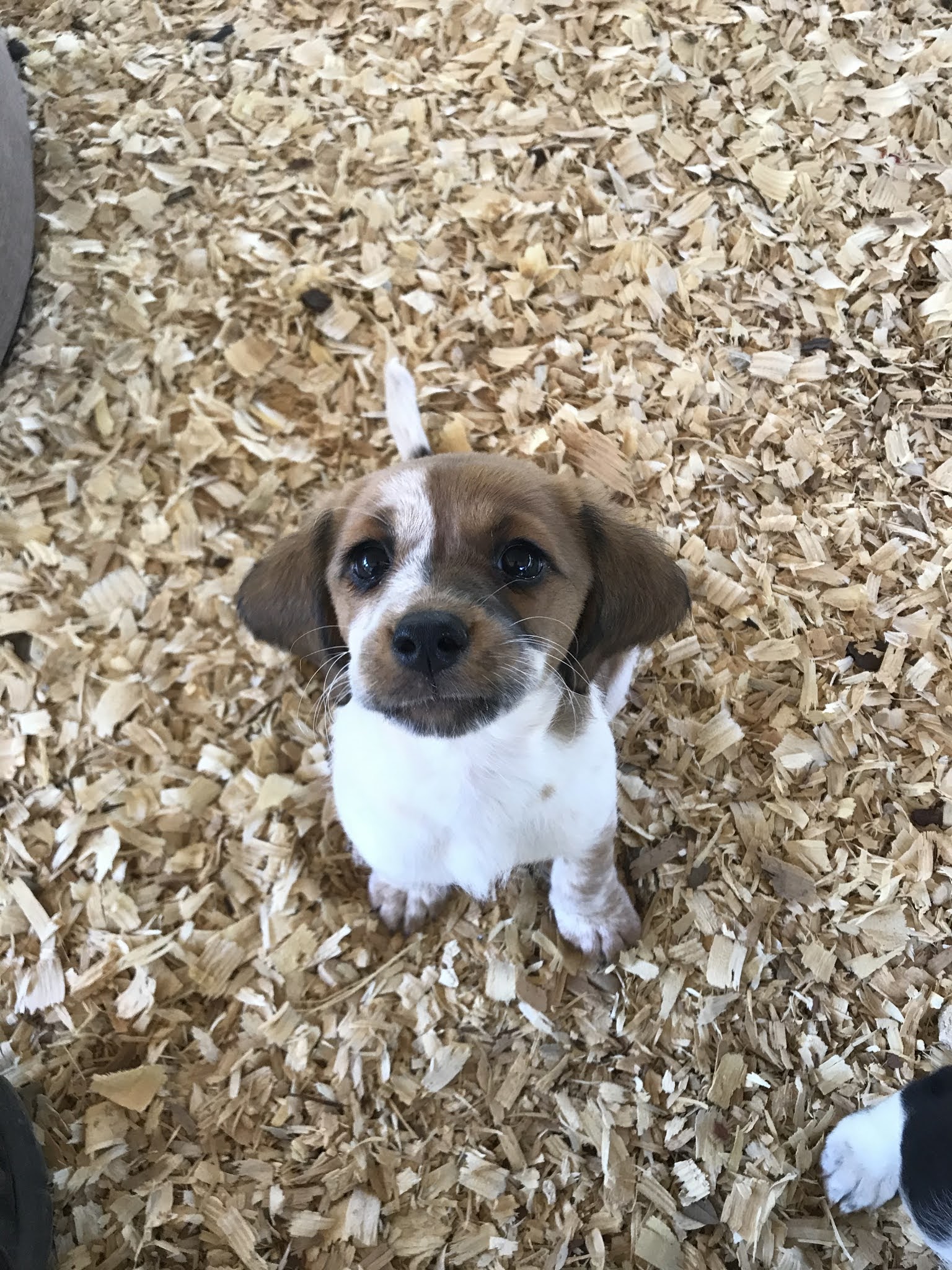
...we've adopted a 13-week old puppy.

Her name is Twyla.

She has opinions about things, too. Already.
***
And when you're needing your space
To do some navigating
I'll be here patiently waiting
To see what you find

'Cause even the stars, they burn
Some even fall to the earth
We've got a lot to learn
And God knows we're worth it

No, I won't give up on us
Even if the skies get rough
I'm giving you all my love
I'm still looking up